There is so much that we can learn from the incredible stories of the Prophets (AS)!
In this mini series, Mufti Menk explains what happened to the Prophets (AS). He also illustrates how we can apply the learnings from their stories to our everyday lives In Shaa Allah.
Looking for a way to gain one thousand good deeds, whilst also removing one thousand bad deeds?
If so, you have come to the right place – this very simple dua can help you achieve just that InshAllah.
Dua:
Say ‘Subhan Allah’ 100 times a day InshAllah
subhanAllah
Hadith:
Mus’ab bin Sa’d narrated that his father had been in the company of Allah’s Messenger (SAW) who said: “Is one amongst you powerless to get one thousand virtues every day?” Amongst those who had been sitting there, one asked: “How one amongst us can get one thousand virtues every day?” Prophet (SAW) replied: Recite: ‘Subhan Allah’ one hundred times for (by reciting them) one thousand virtues are recorded and one thousand vices are erased. – Sahih Muslim, Book 35, Number 6517
Surah An-Nasr takes its name from a word in the first verse.
Muhammad Marmaduke Pikthall [The Meaning of The Glorious Quran] states that it is one of the very last revelations, having come to the Prophet (SAW) only a few weeks before his death.
Narrated by Umar ibn Al-Khattab (RA): One day while we were sitting with the Messenger of Allah (SAW), there appeared before us a man whose clothes were exceedingly white and whose hair was exceedingly black; no signs of journeying were to be seen on him and none of us knew him. He walked up and sat down by the Prophet (SAW).
Resting his knees against his and placing the palms of his hands on his thighs, he said, “O Muhammad (SAW), tell me about Islam.” The Messenger of Allah (SAW) said: “Islam is to witness that there is no God but Allah and Muhammad is the Messenger of Allah, to establish prayer, to give the alms, the fast the month of Ramadan, and to perform pilgrimage to the House if he is capable of travel.” The man said, “You have spoken rightly,” and we were amazed at him asking him and saying that he had spoken rightly.
Then he said, “Tell me about faith (Iman).” The Prophet (SAW) said: “Faith is to believe in Allah (SWT), His angels, His books, His messengers, and the Last Day, and to believe in the providence of both good and evil.” The man said, “You have spoken rightly.
Then tell me about excellence (Ihsan).” The Prophet (SAW) said: “Excellence is to worship Allah (SWT) as if you see Him, for verily, He sees you.”
The man said, “Then tell me about the Hour.” The Prophet (SAW) said: “The one who is asked does not know more than the one asking.”
The man said, “Then tell me about its signs.” The Prophet (SAW) said: “When the slave girl gives birth to her master, when the naked and barefooted will become chiefs of the people, and when the shepherds of black camels will exult themselves in constructing building.”
Then he left and I stayed for a time. Then the Prophet (SAW) said: “O Umar (RA), do you know who the questioner was?” I said, “Allah and His messenger know best.” He said: “He was Jibril (AS), who came to teach the people their religion.” – Abu Dawud; 4695, Sahih Muslim; 5, Ibn Majah; 63
Islam, Iman, Ihsan
Explanation by Shaykh Muhammad ibn Saalih al-‘Uthaymeen:
A person should mix with people and not seclude himself
It is possible for the Angels to appear to the people in the form of a man
The permissibility of a person asking a question about something he has knowledge of in order to teach those who do not know
The religion is not complete without testifying that none has the right to be worshipped in truth except Allah (SWT) and that Muhammad (SAW) is the Messenger of Allah (SWT)
The five pillars are the foundation of Islam
Iman includes six matters: Belief in Allah (SWT), His Angels, His Books, His Messengers (AS), The Last Day and the Qadr (Divine Decree), the Qadaa (occurrence of that Divine Decree) and the good & the bad
Belief in Allah (SWT) is the most important part of Iman, which is why it was superseded in the response “It is to believe in Allah (SWT)”
Worship Allah (SWT) as if you see Him. If you cannot do this, worship Him knowing that He is seeing you
No one has knowledge about the Hour, except for Allah (SWT)
One of the signs is a slave girl giving birth to her female slave master. This is a figurative expression indicating expedient growth and an abundance of wealth and its dispersing amongst its people. Another interpretation of this describes parents becoming slaves to their children and the act of children respecting and honoring their parents being reversed
Narrated by Umar ibn Al-Khattab (RA): I heard Allah’s (SWT) Apostle (SAW) saying, “The reward of deeds depends upon the intentions and every person will get the reward according to what he has intended.
So whoever emigrated for worldly benefits or for a woman to marry, his emigration was for what he emigrated for.” – Sahih Bukhari, Volume 1, Book 1, Number 1
Surah Al-Masad really does put this World into perspective.
It is about one of the Prophet’s (SAW) uncles, who bitterly opposed him – Abu Lahab (Abdul ‘Uzza).
Abu Lahab and his wife made it their business to torment the Prophet (SAW). For example, Abu Lahab’s wife carried thorn bushes and placed them in the sand where she knew the Prophet (SAW) was sure to walk barefoot.
This Surah talks about how the wealth of Abu Lahab will not help him as well as what will happen to him and his wife in the Hereafter, based upon their actions in this World.
Want to get your sins cleansed InshAllah? (Note: It is said that this is for Minor Sins only).
There is a very simple dua that you can read, which only takes a few minutes time!
Dua:
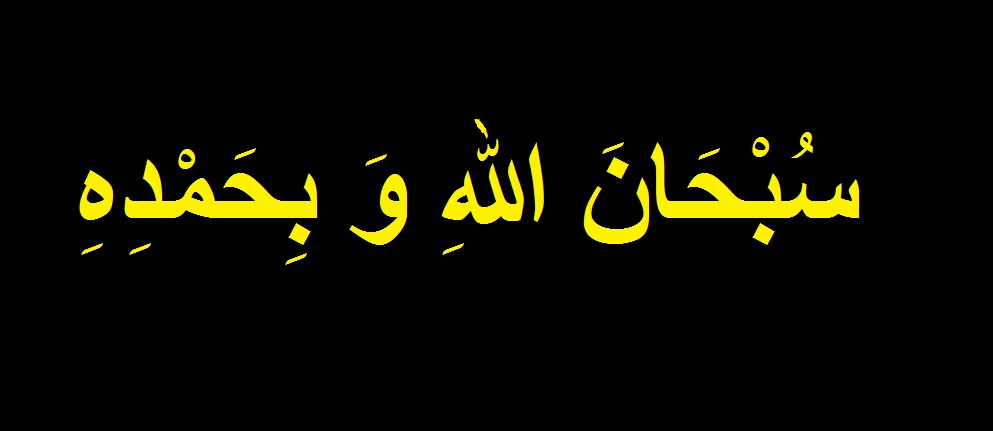
Say ‘Subhan Allahi wa bihamdihi’ 100 times a day.
Subhan Allahi wa bihamdihi
Hadith:
Narrated by Abu Huraira (RA): Allah’s Apostle (SAW) said, “Whoever says, ‘Subhan Allahi wa bihamdihi,’ one hundred times a day, will be forgiven all his sins even if they were as much as the foam of the sea.” – Sahih Bukhari, Volume 8, Book 75, Number 414.
Surah Ikhlas is a very short Surah, which carries tremendous benefits. It is easy to memorise and is something we should try and recite regularly InshAllah.
Hadith:
Narrated by Abu Said Al-Khudri: The Prophet (SAW) said to his companions, “Is it difficult for any of you to recite one third of the Quran in one night?”
This suggestion was difficult for them so they said, “Who among us has the power to do so, O Allah’s Apostle (SAW)?”
Allah Apostle (SAW) replied: “Allah (the) One, the Self-Sufficient Master Whom all creatures need. (Surah Ikhlas) is equal to one third of the Quran.” – Bukhari, Volume 6, Book 61, Hadith 534


 Western Muslim UK